

Share this
by Quality Storage Buildings Team on October 1, 2026 at 12:23 PM
Whether you need a permit for a shed in Liberty Hill depends on which of three jurisdictions your property sits in. Inside the city limits, the City of Liberty Hill lists storage sheds among the structures that require a building permit. In the City's extraterritorial jurisdiction, or ETJ, the City says building permits from the City are not required. Out in unincorporated Williamson County, the County says it has no zoning regulations and does not require new residential construction to conform to any building code at all.
So the useful question is not what size shed needs a permit — it is whose rules apply to your dirt. That takes about five minutes to settle, and this post shows you how, using what the City and the County publish themselves.
Three answers, because there are three authorities
Here is the short version, in each authority's own terms, as published as of August 2026.
| Where your property is | Who regulates it | Building permit for a shed? |
|---|---|---|
| Inside Liberty Hill city limits | City of Liberty Hill — zoning, subdivision, sign regulations, and all other City ordinances | Yes. Storage sheds are on the City's permit list |
| In the City's ETJ | City of Liberty Hill — subdivision and sign regulations only | No, per the City: "building permits from the City aren't" required, unless a development agreement covers your property |
| Unincorporated Williamson County | Williamson County — no zoning, no adopted residential building code | No county building permit. The County asks for a Certification of Compliance that checks floodplain |
The City states the principle plainly: "From a planning and zoning perspective, where your property is located—inside the City Limits, in the ETJ, or out in the County—determines which rules apply to you."
Inside the city limits: sheds are on the permit list
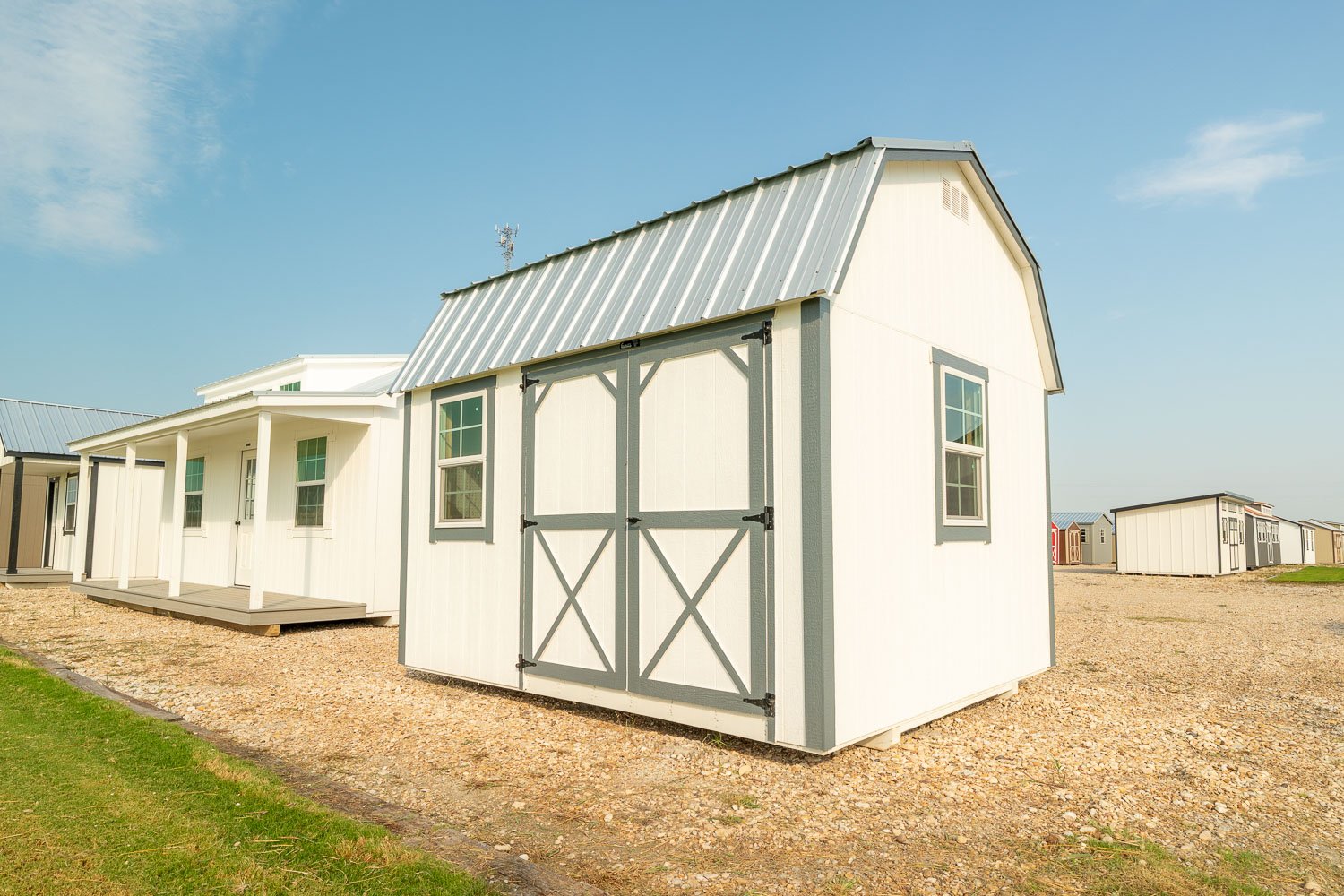
The City of Liberty Hill's rule is broad. "A Building Permit is required for any construction which physically changes or adds structures to the property." Under the list of projects that require one, the City names new buildings specifically: "Dwellings, Garages, Storage Sheds, Carports, Gazebos, Arbors, etc."
That is worth reading carefully, because storage sheds are named outright. For contrast, the City's list of projects that do not require permits includes house painting, cabinets, wallpaper, non-structural roof covering, and fencing. A fence is exempt. A shed is not on that list.
A few practical details if you are inside the line. The City has adopted the 2021 International Residential Code and 2021 International Building Code, along with the 2021 plumbing, mechanical, energy conservation, and fire codes and the 2020 National Electric Code. Applications go through the MyPermitNow online portal, where you can also pay fees, submit plans, and request inspections. A building permit expires after 180 days unless construction continues or an extension is granted.
One thing the City's permit page does not publish is a square-footage cutoff for small accessory buildings. The general version of that question is covered in our guide to whether a shed needs a permit in Texas generally. Liberty Hill simply lists storage sheds without attaching a size to them. If your building is small and you are hoping it falls under a threshold, that is the one question to settle by phone rather than by assumption. The Building Official's office is at 512-548-5507.
In the ETJ, the City regulates less than you would think
An ETJ is the unincorporated land just outside a city's boundaries where the city holds limited authority. The City of Liberty Hill describes its own reach there as narrow: "the City can enforce subdivision and sign regulations within the ETJ, as outlined in its 1445 Interlocal Agreement with Williamson County."
For a shed, the City is direct about what that means. If your property is in the ETJ, "Sign permits are required, but building permits from the City aren't—unless there's a development agreement in place for your property." Development still touches the City in other ways — you may need to plat with the City and obtain stormwater permits, depending on the project.
The reason an ETJ exists at all is set out in state law. Texas Local Government Code Section 42.001 declares it "the policy of the state to designate certain areas as the extraterritorial jurisdiction of municipalities to promote and protect the general health, safety, and welfare of persons residing in and adjacent to the municipalities."
How far it reaches is a function of population. Section 42.021(a) gives a city with fewer than 5,000 inhabitants a half-mile ETJ, and a city with 5,000 to 24,999 inhabitants a one-mile ETJ. The Census Bureau put Liberty Hill at 3,646 residents in the 2020 census and estimated 13,317 as of July 1, 2025. A city that size falls in the one-mile band.
Do not take that as a map. Section 42.021(e) provides that an annexation commenced after January 1, 2023 does not expand a city's ETJ unless the landowner asks for it. The boundary worth trusting is the one on the City's map.
Out in the county: no zoning, no building code
Here is what Williamson County says about itself.
On zoning: "There are no zoning regulations in Williamson County. If you are inside the city limits, you must follow the city's zoning regulations."
On building codes, the County's own language is unusually blunt: "Williamson County has no authority to zone property for land use nor does the County have the authority to issue a Certificate of Occupancy." It goes on to state that the County "has not adopted a resolution or order requiring the application of Subchapter F, 'Residential Building Code Standards Applicable to Unincorporated Areas of Certain Counties', as found in Section 233 of the Local Government Code. Therefore, Williamson County does not require any new residential construction to conform to any building code."
There is no county shed permit to pull, because there is no county residential building code to enforce. What the County does ask for is narrower. You contact the Williamson Road & Bridge Division for a Certification of Compliance, which the County describes this way: "This permit verifies if the property is in a flood plain." Beyond that, "You will not need anything from the Road & Bridge Department, unless you are putting in a driveway."
The County is also careful to say it is not the only authority in play. Other agencies "may require permitting including, but not limited to, cities (within their ETJ), Emergency Services Districts, TCEQ, the Williamson County and Cities Health District." If your project involves a septic system, the County Engineer's office handles sewage facility questions at 512-943-3330.
One thing that will not reach a backyard shed: the county fire code. Unincorporated Williamson County uses the 2018 International Fire Code, but the County states its purpose is to set requirements for "public buildings, commercial establishments, and multi-family residential dwellings consisting of four or more units."
The authority almost everyone forgets: ESD #4
Liberty Hill has no fire department of its own. As the City puts it: "fire protection services for the Liberty Hill area are provided by Williamson County Emergency Services District (ESD) #4. ESD #4 operates as an independent entity with its own taxing, reviewing, and permitting authority."
That independence has teeth in the City's process. The City states that "All projects must receive approval from both the City and ESD #4, unless a written exemption has been granted," and it warns that its own published regulations "do not include ESD #4 (fire) requirements." ESD #4 runs its permitting through LHFDpermits.com.
Whether a backyard storage building triggers anything from ESD #4 is not something we can answer from the outside — the district's portal documents construction plan review and operational permits rather than residential accessory buildings. What we can tell you is that it is a real fourth authority in this specific area, and that the City treats its sign-off as part of the process. Ask, rather than assume it does not apply to you.
How to find out which one you are in, in about five minutes
The City publishes two ways to check.
- The City's interactive GIS map. Search your address and check whether the property falls inside the red boundary line, which the City says "represents the City Limits layer." The City adds a second confirmation: "Only properties within the City Limits are subject to the City of Liberty Hill's zoning regulations."
- Your appraisal district record. Look your property up on the Williamson County Appraisal District site and scroll to the section titled "2025 Entities and Exemptions." If you see "CLH– City of Liberty Hill" listed as one of your taxing entities, you are in the city limits. In the City's words, "If it's not listed, that means your property is not located within the City Limits of the City of Liberty Hill."
That second method is the fastest honest answer available, because it uses a record you can pull up on your phone and it does not depend on reading a map correctly. If you would rather just ask, the City's planning team takes calls at 512-548-5519 and, in the City's words, "can answer any questions you have."
What this does not cover
Jurisdiction is the biggest variable in Liberty Hill, but it is not the only one. Deed restrictions and homeowners associations operate independently of any of the three authorities above, and a subdivision can prohibit a building the City would happily permit — our Texas shed permit guide covers that separately. Septic fields and their setbacks are their own question, handled through the County Engineer.
Treat everything here as general information rather than a determination about your property. Permit rules change, so confirm what applies to your parcel today with the offices named above.
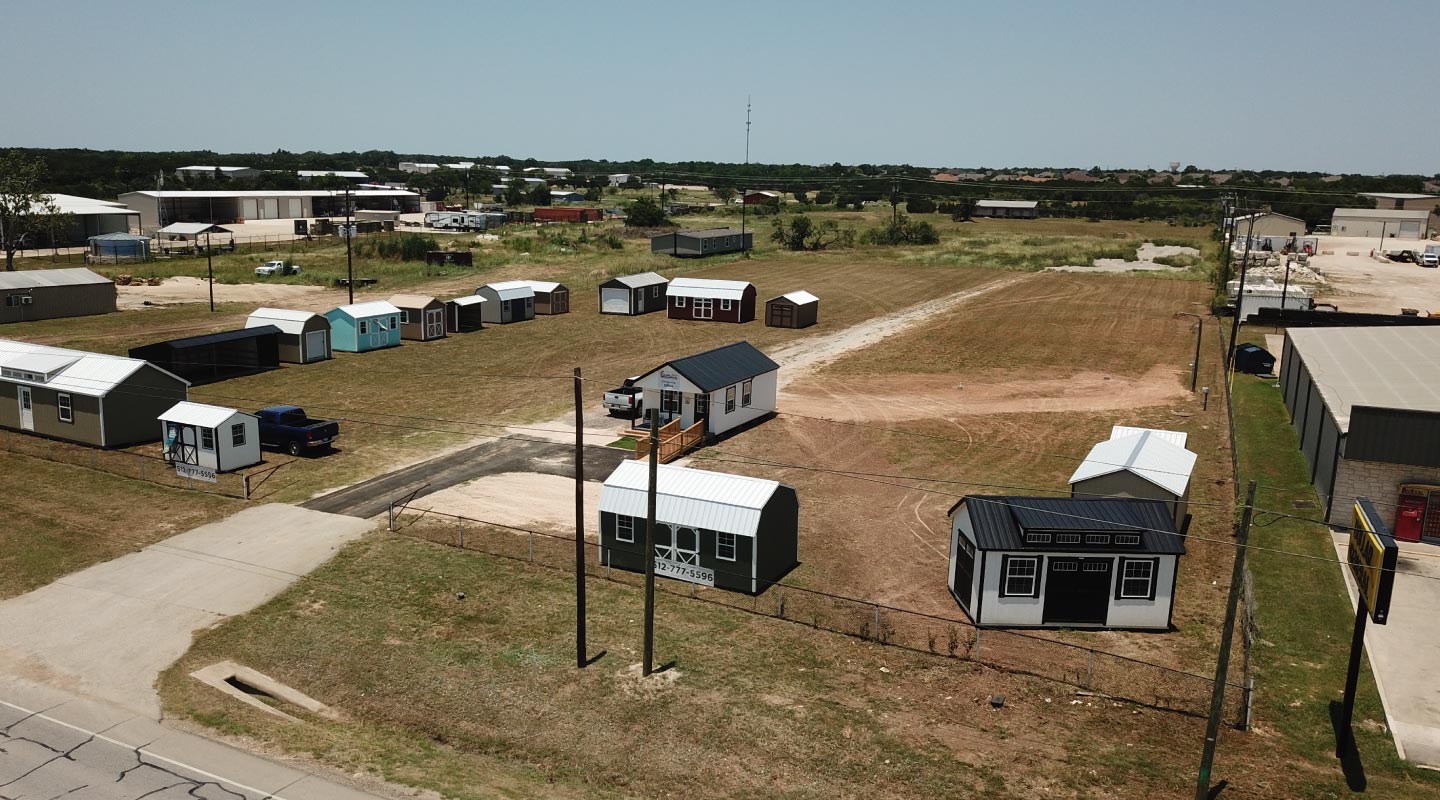
If you want to see the buildings before you work out the paperwork, our Liberty Hill lot on TX-29 is at 15570 TX-29, Liberty Hill, TX 78642, open Mon-Fri: 8-5 & Sat: 10-3, and the number there is 512-777-5596. You can also see all three of our Texas locations.
Frequently asked questions
Do I need a permit for a shed in Liberty Hill, Texas?
It depends on which jurisdiction your property is in. Inside the city limits, yes — the City of Liberty Hill lists "Storage Sheds" among the new buildings that require a building permit. In the City's ETJ, the City states that "building permits from the City aren't" required unless a development agreement covers your property. In unincorporated Williamson County, there is no county building permit for a shed, because the County has not adopted a residential building code.
What size shed can I build in Liberty Hill without a permit?
The City of Liberty Hill does not publish a square-footage exemption for accessory structures on its building permit page. It lists storage sheds as requiring a permit without attaching a size to them. Confirm whether any size threshold applies directly with the Building Official's office at 512-548-5507 rather than relying on a number you read somewhere.
Do I need a permit for a shed in unincorporated Williamson County?
Not a county building permit. Williamson County states that it "does not require any new residential construction to conform to any building code" and that "There are no zoning regulations in Williamson County." What the County does ask for is a Certification of Compliance from the Williamson Road & Bridge Division, which it describes as a permit that "verifies if the property is in a flood plain." Other agencies, including emergency services districts and the health district, may still have requirements.
What is an ETJ, and does Liberty Hill require a building permit there?
An ETJ, or extraterritorial jurisdiction, is unincorporated land next to a city where the city holds limited authority. Liberty Hill describes its authority there as subdivision and sign regulations, "as outlined in its 1445 Interlocal Agreement with Williamson County." For building, the City is specific: "Sign permits are required, but building permits from the City aren't—unless there's a development agreement in place for your property."
How do I find out if my property is in the city limits, the ETJ, or the county?
The City publishes two methods. You can search your address on the City's interactive GIS map and check whether it falls inside the red boundary line representing the City Limits layer. Or you can look up your property on the Williamson County Appraisal District site and check the "2025 Entities and Exemptions" section — if "CLH– City of Liberty Hill" appears as a taxing entity, you are inside the city limits. The City's planning team also answers this by phone at 512-548-5519.
Does Williamson County have zoning?
No. The County states directly: "There are no zoning regulations in Williamson County. If you are inside the city limits, you must follow the city's zoning regulations." The County also says it "has no authority to zone property for land use nor does the County have the authority to issue a Certificate of Occupancy."
Does the fire district have to approve my building?
Liberty Hill has no fire department of its own, so fire protection comes from Williamson County Emergency Services District #4, which the City describes as "a separate permitting authority" with "its own taxing, reviewing, and permitting authority." The City states that "All projects must receive approval from both the City and ESD #4, unless a written exemption has been granted." ESD #4's published permit categories cover construction plan review and operational permits rather than residential accessory buildings, so the sensible step is to ask the district through LHFDpermits.com rather than assume either way.